You are currently browsing in offline mode.

Why Website Projects Take Longer Than They Should

10 min read

 . 

By Admin

Guide to complete your project on time
Every website project starts the same way: with a simple, confident idea. We need a new website. We need to redesign the one we have. We need it live by a certain date. That confidence rarely survives contact with reality.

The first week quietly becomes the second. A design review runs long. The content still isn't ready. Someone adds a requirement that wasn't in the original brief. Development is waiting on an approved design; design is waiting on final copy. Before long, a project that looked like a few weeks of work is still going months later — and nobody can point to the one thing that went wrong.

So, why do website projects take longer than they should? We put that question to our LinkedIn audience directly.
46% told getting started is the harder part of website projects

What Actually Slows a Website Project Down

We asked: what's the hardest part of building a website? The responses were revealing — 46% said getting started, 31% said content, 15% said designing, and only 8% said development.

That order matters. The part everyone assumes is the bottleneck — actually building the thing — ranked dead last. Conversations with the designers, developers, and project leads we spoke to afterward backed up the pattern: getting started, unclear ownership, and fragmented feedback create more delay than the design and development work itself.

A website project usually doesn't get delayed by one major problem. It gets delayed by a chain of small decisions that aren't made at the right time. Here's where that happens, and what actually fixes each one.

1. The Project Takes Too Long to Start

Every project begins with questions: Who is the website for? What are we trying to achieve? Which pages do we actually need? Who owns the content? Who approves the work? When these go unanswered early, the team starts working from assumptions — and assumptions eventually turn into revisions. A designer builds a homepage from the initial brief; two weeks in, a stakeholder mentions they're actually targeting a different audience now. The problem isn't that the designer worked too slowly. The project started without enough clarity to work from.

The fix: before design begins, nail down the sequence — goal, audience, scope, content requirements, functionality, decision-makers, timeline. A clear starting point saves far more time than trying to make the team move faster once things are already underway.

It also helps to not start from a blank canvas at all. This is exactly the gap Coco Grid Marketplace is built for, a library of real-world Figma templates that give designers, founders, and product teams a solid, customizable starting point instead of an empty file. You still make it yours; you just stop paying the "getting started" tax that 46% of our poll pointed to as the hardest part of the whole process.

2. Content Becomes the Invisible Bottleneck

Content came in as the second-biggest source of friction in our poll. Design and development can move quickly right up until someone asks the obvious question: where's the final copy? Then the familiar cycle starts — design goes out with placeholder text, revised copy comes in, the layout shifts to fit it, a section runs too long, the copy changes again, and development has to absorb it mid-build.

Content isn't something you bolt onto a finished website — it shapes the structure of the site itself. Headlines drive layout. Body copy affects spacing. Product information dictates page structure. When content shows up late, it doesn't just delay a page — it forces rework that could have been avoided.

The fix: treat content as part of the project from day one. Before design gets too far along, define what content exists, what needs rewriting or creating, who owns each piece, and when it needs approval. Even without final copy in hand, a clear content structure beats designing around placeholder text indefinitely.

3. Feedback and Approvals Become Their Own Bottleneck

A homepage goes out for approval. The marketing manager comments in the design file. The founder emails separately. Sales sends another round on Teams. Someone else raises a point in a meeting that never makes it into writing. The designer now has several competing versions of what the website is supposed to be — and feedback was never the real problem. Fragmented, slow feedback is. A designer can finish a homepage in two days; if it then takes five days to get a decision, the project hasn't moved in that time, it's simply been waiting.

The fix — one source of truth, one decision-maker: keep feedback in a single place, and set a defined review window — designs shared Monday, consolidated feedback by Wednesday, final changes by Friday. Once a section is approved, treat that approval as a decision; if someone wants to revisit it later, that's a new change request, not an invisible revision. This doesn't eliminate feedback. It makes it predictable, which is usually all a project needs.

4. Design and Development Don't Always Speak the Same Language

A design can look completely straightforward on screen, and then development starts and the gaps surface: the component needs states nobody designed for, mobile wasn't accounted for, the CMS has limitations nobody flagged, or a third-party integration behaves differently than expected. Now the team has to stop and clarify decisions that should have been made earlier.

The fix: before a design is considered final, talk through responsive behavior, component states, interactions, technical constraints, CMS requirements, and accessibility. The earlier these get discussed, the cheaper they are to resolve.

5. Small Changes Quietly Snowball

A request sounds harmless enough: can we just change this button? Then move this section. Then add one more testimonial. None of these seems significant on its own, but collectively they create real rework and a long chain of interruptions — the team loses context, decisions get revisited, work gets duplicated, and the project feels like it's constantly moving without getting closer to launch. The issue isn't that teams shouldn't accept changes. It's not distinguishing planned work from new work.

The fix: use a simple change-control process. When a new request comes in, ask whether it's part of the original scope — if yes, fold it into the planned work; if not, decide whether it replaces something, adds to the timeline or cost, or moves to a later phase. And group decisions together: instead of one question, one email, one revision at a time, aim for review, consolidate, decide, execute. Fewer handoffs mean fewer chances for misunderstanding.

6. The Root Cause Is Usually Unclear Ownership

Ask these at the start of any project: Who owns the content? Who approves the design? Who makes the final call when stakeholders disagree? Who signs off on development? If the honest answer to any of these is "we'll figure it out," a future delay has probably already been baked in. This gets harder with outsourced teams too — client to agency to designer to developer adds hops unless ownership and approval authority are explicit from the start. Without clear ownership, everyone can weigh in, but nobody can confidently say this is approved, let's move forward.

A Simple Framework for Keeping Website Projects on Track

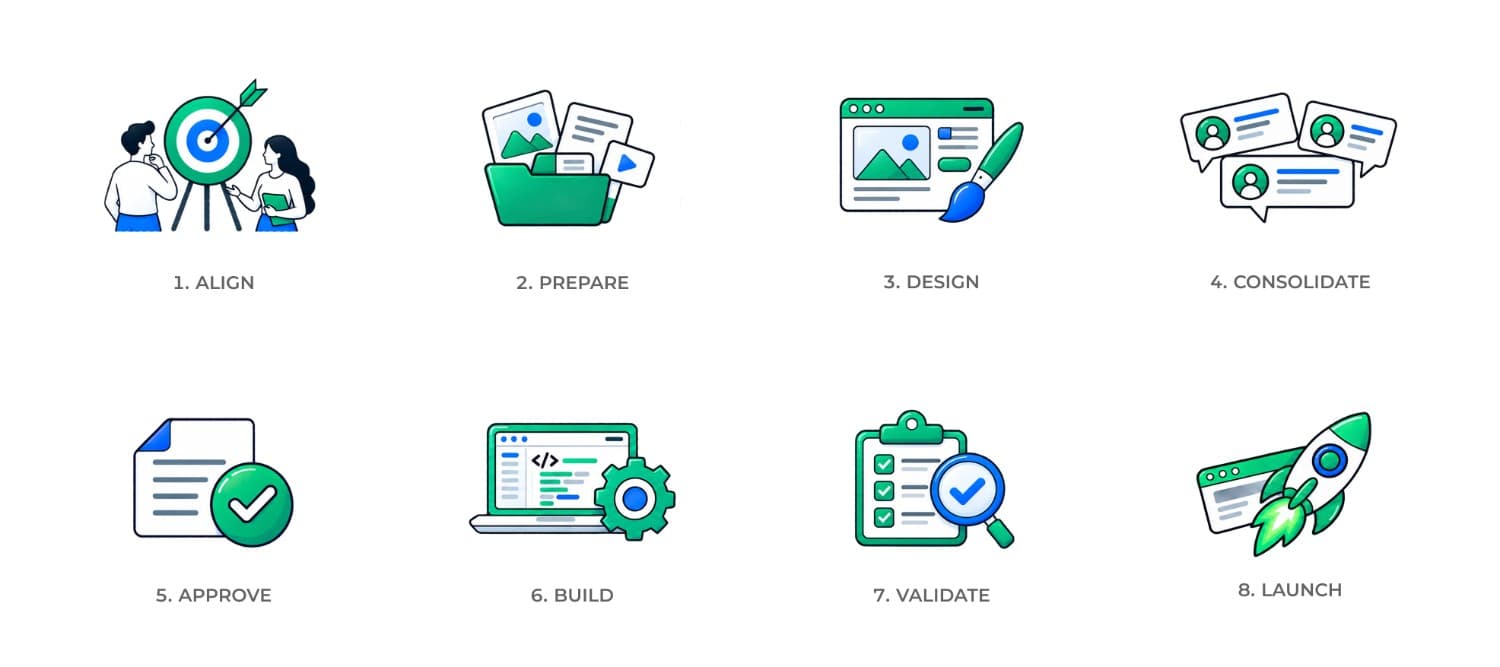
A faster website project doesn't necessarily need a faster design or development team. It needs a better process:
A Simple Framework for Keeping Website Projects on Track
  1. Align: Define the business goal, audience, scope, functionality, and success criteria.
  2. Prepare: Get content, assets, technical requirements, and stakeholders ready before production starts — starting from a proven template rather than a blank file saves real time here.
  3. Design: Create the experience, validate the structure, and account for responsive and technical requirements.
  4. Consolidate: Collect feedback in one place instead of letting it spread across emails, chats, and meetings.
  5. Approve: Define who makes the final decision, and set clear approval points.
  6. Build: Start development with an approved direction and clear requirements.
  7. Validate: Test across devices, browsers, content, functionality, and performance.
  8. Launch: Deploy with a defined launch checklist and clear ownership for post-launch fixes.

The goal isn't to remove every revision. The goal is to prevent the unnecessary ones.

How to Make Your Next Website Project Faster

Before your next project kicks off, run through these questions.

Before the project
  • What is the primary business goal, and who is the decision-maker?
  • What is included in the scope?
  • What content is ready, and what still needs to be created?
  • What technical constraints already exist?
During design and development
  • Is feedback coming through one channel, with one review window?
  • Are mobile states and technical constraints already reviewed?
  • Are design changes going through a change-control process?
  • Are content and assets final before build starts?
Before launch
  • Has the website been tested across devices and browsers?
  • Are analytics, tracking, and redirects configured?
  • Is there a post-launch ownership plan?

How Coco Grid Helps Teams Move Faster

At Coco Grid, we're a UI/UX design agency that helps startups, SaaS companies, and enterprises design better digital experiences — user research, UX and visual design, design systems, and development for websites, apps, and SaaS platforms. Our approach centers on understanding users, simplifying complex experiences, and creating products that are both functional and visually engaging.

Given that getting started was the single biggest pain point in our poll, it's also why we built the Coco Grid Marketplace, a library of real-world Figma templates designed for speed and real-world application. The philosophy is simple: don't start from scratch, start with a solid foundation and make it yours. Each template is built to be customized around your brand, content, and requirements, so a project can move from a blank page to a working starting point in hours instead of weeks. We have a FREE TEMPLATE just for you to get started.

Whether you're starting a website from scratch, redesigning an existing platform, or trying to get a stalled project moving again, the first step is the same: understand where the process is actually getting stuck. A better website project doesn't necessarily need more people. It needs fewer unnecessary loops — and sometimes a better starting point.

We would like to conclude by saying that:

A website project doesn't go long because someone forgot to work hard enough. More often, it goes long because too many decisions are left open for too long.

Get the right people involved early. Get the content moving. Keep feedback in one place. Make ownership clear. Control scope. Start from a solid foundation instead of a blank page where you can.

Don't measure a website project only by how quickly your team can design or build. Measure how quickly the entire team can make good decisions. That's where website projects really speed up.

Frequently Asked Questions

  1. Why do website projects take so long?Website projects often take longer than expected because of unclear requirements, delayed content, slow approvals, fragmented feedback, scope changes, and repeated revisions between design and development.
  2. What is the biggest cause of website project delays?There isn't one universal cause, but delays commonly come from unclear scope, content not being ready, slow stakeholder approvals, and changing requirements.
  3. How can I speed up a website project?Define scope and decision-makers early, prepare content before design, use one feedback channel with set approval deadlines, involve development early, and start from a proven structure rather than a blank canvas where possible.
  4. Can templates help speed up a website project?Yes. A well-built template gives design and content a working structure to react to instead of starting from nothing, which shortens the 'getting started' phase most teams find hardest. Coco Grid Marketplace offers Figma templates built for exactly this.
  5. Why does website content delay projects?Content affects page structure, layout, and hierarchy. When content arrives late or changes after design approval, designers and developers often need to rework completed sections.
  6. Why does feedback slow down website projects?Feedback itself isn't the problem. Delays occur when feedback is fragmented, contradictory, or comes from multiple stakeholders without a clear decision-maker.
  7. Should design and development happen separately?They can have distinct responsibilities, but shouldn't operate in isolation. Early communication helps catch technical constraints and implementation issues before they become expensive changes.
  8. Does outsourcing website development make projects slower?It can, if communication, ownership, and approval processes are unclear. With a well-defined operating model, an external team can increase capacity and help projects move faster.
Let’s Connect

“ Looking for a creative partner? Let’s connect and bring your ideas to life! ”

CONNECT.CREATE.ELEVATE